Tampilkan postingan dengan label Trendy Products. Tampilkan semua postingan

Turning Your PC into PS3 with Sony’s Move.ME

Sony Computer Entertainment America earlier this month has released a new software application helping hobbyist, academics, researchers, and students to turn their PCs in to PlayStation3 (PS3) with use of PlayStation Move motion controller as an input device on their own PCs. The new software application by the name of Move.ME could also help medical researchers to prototype, such applications as rehabilitation applications for patients undergoing physical therapy, as well as helping design students to develop new creative concepts in gaming within the areas of 3D modeling, motion capture as well as augmented reality.


The new software application is compatible with Windows or Linux based PCs. Other type of devices such as tablet PCs and smartphones can receive PlayStation Move’s tracking data if they can be connected to s PS3 system. The Move.Me will be available for download from PlayStation Network this spring.


High Performance ARM Based Microcontroller for Industrial Application by Fujitsu Semiconductor

Fujitsu Semiconductor Europe has released series of microcontrollers that are designed for industrial applications such as health care sector as well as medical technology. The newly developed FM3 microcontrollers are based on ARM® Cortex TM-M3 core with special peripheral functions. In addition to peripheral functions, the new FM3 series benefit from number of improvements in its peripheral macros such as dedicated encoder inputs for determining rotor position resulting in a reduced load on the CPU.

In addition to this, the FM3 series features three independent high precision and very fast 12-bit A/D converters with 16 input channels allowing accurate sampling, making them ideal for high-speed precision motors and other components in automation applications, resulting in controlling two motors independently. Furthermore, the new FM3 microcontrollers (MCU) have an integrated, high-speed NOR flash memory (up to 1 MB), which is designed for 100,000 write cycles and data storage for up to 20 years


Development of High-Speed Multi-Channel Transceiver Circuit, Capable of Extending In-Server Data Transmission Distances by Fujitsu

Fujitsu has successfully developed a high speed multi-channel transceiver circuit which operates at 10 Gbps. The new transceiver would help in extending the in-server data transmission distances by a factor of 1.7 times in comparison to commercially available technologies.

The new transceiver would be used as backplane serving as communication channel within multi-process servers that combines multiple CPUs for achieving higher performance. This new technology would compensate for data signal distortion which is evident when the channels are extended. The new technology would extend the current distance from 70 cm to 120 cm, contributing to form large scale high performance server systems which connects far more processors that was previously possible.

The core of the new technology is a new signal processing algorithm that compensates for the amplitude distortion as well as phase distortion which emerges over long backplane channels, so that the signal distortions resulting from a maximum of 41 dB of loss at 10 Gbps can still be completely corrected, resulting in extension of backplane channel by factor of 1.7 to 120 cm. The key characteristics of the new technology are phase-distortion compensation and precise clock-signal generation to minimize the negative impact of noise components that remains after compensating for distortions that occurs from long signal channels.


Introduction of Cotton Fiber in Automobile Interior Surface Materials

In an effort to reduce petroleum-based materials such as PET fiber in cars interior, specifically in car interior surface materials, Mitsubishi Motors has developed a new interior surface materials that incorporates cotton fibers in PET (Polyethylene terephthalate) materials, capable of attaining high standards required for automobile parts due to its effective original structural design and a flame retardant treatment.

The newly developed material can be used in not only automobile seats but also in other area including ceilings and trim surfaces. The initial calculation by company shows reduction of CO2 emission by 20% compared to conventional products. The new fiber is a new addition to the “Green Plastic” lineup of Mitsubishi Motor.


Industry’s First Mass Production Technologies help Carbon Fiber Reinforced Plastic to go Mainstream

Up to now carbon fiber-reinforced polymer were used extensively in high-end racing cars due to its high manufacturing cost. However, the material’s unprecedented strength-to-weight ratio as well as its low weight made it an essential material to use in high-performance racing automobiles. The high cost of carbon fiber-reinforced polymer, equipment, as well as relatively limited pool of expert individuals how are capable of working with it ,up to now has been a major factors in introducing the material in mass-produced cars.

The Carbon fiber-reinforced Polymer has a wide applications ranging from aerospace and automotive fields consumer equipment such as laptops, tripods, fishing rods to name a few. Introduction of Carbon fiber-reinforced Plastic (CFRP) in future EV vehicles has been in many car manufacturers agenda, where its use in automobiles body frame/ cabin frame as well as other parts can play a significant role in manufacturing next generation energy efficient EV vehicles. To respond to this challenge, Teijin Limited has announced new mass production manufacturing technologies for CFRP which significantly reduces the cycle time that is required for molding automotive cabin frame to just less than a minute, paving the way toward use of carbon fiber for mass produced automobiles as well as other types of products.

Teijin newly developed technologies produces three intermediate materials which are made of thermoplastic resin instead of conventional thermosetting resin for molding type of CFRP. In addition to this Teijin has developed such technologies for welding thermoplastic CFRP parts together as well as bonding CFRP with materials such as steel, both of which will help in reducing the use of metal in manufacturing processes. The three intermediate materials are; unidirectional intermediate which is an ultrahigh strength material in a certain direction, isotropic intermediate offering balance of shape flexibility and multidirectional strength and long-fiber thermoplastic pellet, a high-strength pellet made from carbon fiber which is ideal for injection molding of complex parts. Teijin in an effort to demonstrate its cutting-edge new technology has developed a conceptual electric vehicle (EV) featuring a cabin frame made entirely from thermoplastic CFRP, weighing only 47 kilograms, which is approximately one fifth the weight of a conventional automobile frame. This conceptual 4-seat EV is capable of speeding up to 60 km/h with a cruising range of 100 km, embodies Teijin’s vision of super lightweight EVs that are made with CFRP.


Release of Industry’s First One Chip VHF/UHF Low-Noise Amplifier for Mobile Devices by PANASONIC

With an aim to design and manufacture low powered semiconductor products to fit the needs of mobile communication devices as well as radio applications, Panasonic Corporation has announced the development of industry’s first VHF/UHF low-noise amplifier (LNA) which are targeted to be used in mobile devices. The newly developed AN26072A and AN26021A can operate at voltage as low as 1.7 V, eliminating any needs for a 2.8 V power supply.

The new LNAs allow mobile terminals to receive one-Segment broadcasts, multimedia broadcast, which are planned to start in April of 2012 in Japan, plus an ATSC-M/H service in North America.

The new LNAs capability will extend further, with their ability to receive signals even in areas with weak radio waves, for much longer period of time, thanks to high-frequency characteristics with noise level of 1.3 dB and reduced power supply voltage.

The key contributing factors in developing the new LNAs are high-frequency circuit technologies capable of supporting a wide range of power supply voltages, technologies that extending the operating frequency range using feedback circuits, plus power consumption reduction technologies that offer high performance with low power consumption. The samples of the new device will be available by the end of March 2011 a t a unit price of 100 JPY


'Smart Bed' Could Give Patients a Lift When They Need It

Hospitals may one day be equipped with computerized "smart" beds that automatically make adjustments to accommodate a patient's needs. The beds could be useful in stabilizing blood pressures, preventing bed sores and helping to reduce the incidence of sleep apneas, among other things. Discussions with bed manufacturers have been positive, and it's possible the technology could be available for use within two or three years.

"Smart" computerized hospital beds may become a standard of care if negotiations between John LaCourse -- professor and chair of the Department of Electrical and Computer Engineering at the University of New Hampshire -- and hospital bed manufacturers bear fruit.
An algorithm LaCourse invented programs the smart bed to communicate with and respond to medical devices that monitor a patient's condition, permitting fast, automatic responses that could prove especially valuable in the wee morning hours, when fewer staff are on hand, or whenever they are busy with other patients.
A sleeping patient's movements might cause a blood pressure drop, for instance, that a monitor would communicate to the bed which, in turn, would move up or down until the patient's blood pressure became stable.

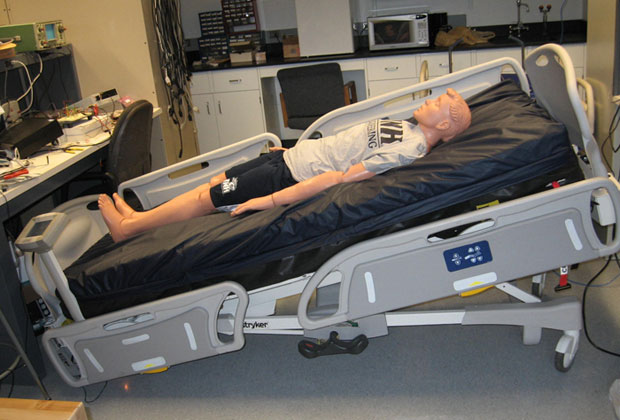
Smart hospital bed can make automatic adjustments to improve patient care.
 "Procedures such as retinal surgery require exact blood pressure levels as part of the healing process," LaCourse explained. "A smart hospital bed would periodically adjust itself to maintain these levels for patients."

The bed could also discern between real and fictitious readings.
"Someone sits on the edge of the hospital bed, and it appears that the patient's blood pressure has fallen," LaCourse explained. "The bed would send a signal to the monitor not to be alarmed -- the reading is due to the visitor's presence and not because the patient's condition has deteriorated."

Quality-of-life conditions such as bed sores could also be addressed. "Instead of requiring hospital staff to move the patient, monitors could send signals to the bed to roll the patient to his left or right to avoid bed sores," LaCourse told TechNewsWorld.

Snoring Cure? 

Sleep apnea -- halted breathing that is a prime suspect in snoring -- responds well to movement. But figuring out when breathing has stopped isn't easy, because the person is asleep. Turns out technology has a solution.

"Microprocessors installed in the bed measuring respiration patterns will sense when breathing has ceased, as well as move the bed in such a way that the individual resumes breathing," said Jon Waters, who is working with Bedford, NH-based Ixxat on sleep apnea research.

"Some research has indicated that patients who suffer from obstructive sleep apnea experience fewer apneas when sleeping on their side, as opposed to sleeping on their back," Waters told TechNewsWorld. "The bed I was working with has a patient roll feature, and I demonstrated the possibility that it be automated because the main goal was to show that an automatic bed movement could be triggered when apnea is detected."

Plug and Play 

LaCourse hopes to incorporate a concept familiar to techies -- plug-and-play -- into his smart hospital bed.

In this environment, "plug-and-play" means that medical devices from blood pressure monitors to breathing machines "share a common technology so they can, in effect, talk to each other and share patient information, which greatly reduces care errors," explained LaCourse.

To realize plug-and-play capability, however, LaCourse's bed automation algorithm must become an industry standard for hospital bed manufacturers. Otherwise, medical device manufacturers will have little incentive to build seamless connectivity into their products.

On that score, so far, LaCourse says, so good.
"We've had discussions with two major bed manufacturers -- Stryker and Hilrom -- and both were receptive to our protocols," he explained, adding that he predicts major progress within two to three years.
"The research and licensing process takes years to complete," said UNH Office for Research Partnerships and Commercialization licensing manager Maria Emanuel. "Two to three years for Dr. LaCourse's technology to come on line means that his project is moving along fairly quickly." 

Practical Preprogrammed Prototype

Until bed manufacturers come online, LaCourse and his team have been working with a prototype in the University of New Hampshire's Bioengineering Laboratory. They've tested it for positive benefits, but also negative side effects -- a concern in any area of patient care.

Such side effects might include motion sickness and the woozy feeling an especially ill person might be prone to on such a moveable bed.
"The intent of the bed movement is not necessarily to oscillate the bed up/down/back/forth, which could potentially be uncomfortable," Ixxat's Waters told TechNewsWorld.

Overall, LaCourse sees "no downside" because the physician remains in control at all times.
"The physician would choose preprogrammed bed movements or program the bed movements," LaCourse explained. "Therefore, the physician would determine the risks and choose the best bed-movement options."

So much university research has an impractical side that UNH's Emanuel is especially pleased with the smart bed's immediate practical potential.
"It's representative of the research being done at UNH -- laboratory work which is meaningful for society," she told TechNewsWorld. "Dr. LaCourse's efforts could lead to significant improvements in patient care."